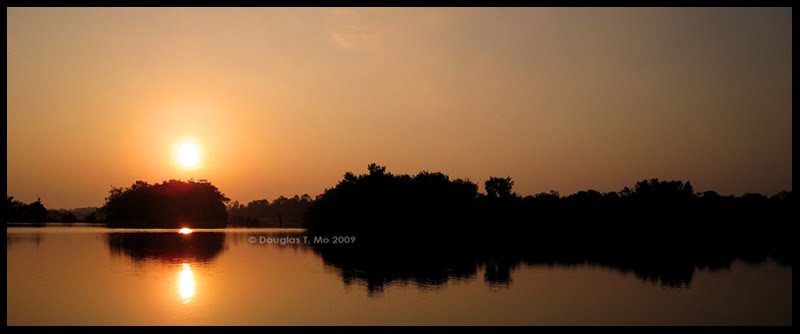



Another Amazonian Sunset, taken on the Rio Solimões, in the Amazonas state, Brazil.
If you managed to survive the self-aggrandising and patronising contents of my two previous "lessons" in photography, you now know that a better camera does not mean better photographs. You now know that good composition is the key to a good image. You will also have noted that -- while an understanding of the rules of composition is an essential starting point on the road to becoming a better photographer -- a mindless adherence to the rules does not for a good picture make.
While not everyone who takes photographs is doing it for the purpose of creating fine art, anyone asking for the ability to take better photographs is asking to improve the artistry of their images. This applies whether you want to grab the best possible holiday snapshots or looking to sell to the Lonely Planet for real money.
Improvement comes through experimentation. And persistence. And practise. Improvement also comes in the editing. In fact, if I could only impart one lesson; if I could hammer only a single thing into the head of every photographer; it is this:
EDIT YOUR PHOTOS.
Now, when I say "edit"; I do not mean you have to manipulate, correct or finesse your pictures through the use of image-editing software. Even if your post-capture editing process does runs through Photoshop; I'm talking about what needs to happen before any horizon is straightened, before any colour is adjusted and certainly before any image of a zebra is inserted into that picture of a pack of rampaging lions. The "editing" about which I speak regards self-censorship. It regards culling. It regards making damned sure that there is that not insignificant group of captures that will be never looked upon by any set of eyes but your own.
How important is this? Important enough that I would be in full support of a law requiring the signing of a binding agreement to edit before a person is even allowed within a half-metre of a camera. And why is it that important? Because the vast majority of your photos are bad. Really shoddy captures. Just pure crap.
Before you start to feel too bad, you should know that the truths I stated in the previous three sentences are universal. They apply to everyone. No matter who is making the images -- whether the photographer is a five-year-old who has just gotten their hands on Mommy's camera-phone or a professional with twenty-five years in the business -- the vast majority of all captures are freaking awful.
As an example, here are three pulled from my "Never to See the Light of Day Unless For Education Purposes" collection (all taken in the Amazon Jungle, Amazonas state, Brazil):

Bad Focusing

More Bad Focusing

Just All-Round Terrible Focusing
Those three shots are just the tip of the iceberg. Out of one-hundred and forty-eight total captures in my time between the Amazon River and the Amazon Jungle, all but seventeen were consigned into the rejects bin.
You might be asking yourself why; given heightened skills with a camera, or the better understanding of photographic techniques, or that unquantifiable "eye", or any of the other things that "good" photographers are said to possess; would the people who know what they're doing still end up with such a multitude of unusable captures. Serious photographers will shoot like crazy to experiment; to test out different angles and viewpoints and framing in an effort to hone their technique and compositional skills. Sometimes, this experimentation will help introduce something new into a photographer's box of tricks; more often, the experimental images just don't work and need to be chopped.
But there is another reason to accumulate a large volume of captures while working with a camera., and that is because, sometimes, skill and technique and "eye" can only get you so far. In photography, sometimes you need to factor in luck.
The importance of luck is inversely proportional with the amount of control a photographer has beyond the camera. A photographer shooting in a studio can set up the lighting and background. Sometimes they even have control of the subject. When everything is just as the photographer desires, no luck is needed. I primarily focus on architecture and landscape photography, which I joke is easier because the subjects don't move. But I don't control the weather or people getting in my way or the pitch and the yaw of the boat on the high seas. So I exposure bracket everything and go crazy with burst shooting modes and annoy the Hell out of travel companions when I wander around that single building for over an hour, shooting everything from every angle just to try to get those few usable captures. And sports and wildlife photographers? Good Lord.
Maximising the amount of captures helps to maximise luck.

Running Towards the Goal, taken in Itaparica, Brazil.
Back in the days of film, shooting en masse used to be the sole purvey of the professionals; or the serious, well-to-do hobbyists. In the age of digital photography; where a single 4GB card in a 10-megapixel camera can hold eight-hundred-and-twenty high-quality JPEG files-worth of vacation pics, or four-hundred-and-ten RAW files for the more serious photog; the ability to create huge volumes of captures is within everybody's wheelhouse. That people certainly aren't hesitating to fill up those memory cards with hundreds upon thousands of captures increases, to a crucial level, the need for a global call to edit.
There is no excuse not to edit. It's such an easy lesson to pick up. Go through your photos and pick out only the right ones to show to other people. That's it. That's the sum total of the lesson. And before you spend hours navel gazing and fretting over what "right" should mean, it means whatever the Hell you want it to mean. It need not mean your best; your most visually stunning photos. It will mean whatever images you need to tell the story you want to tell. Even bad captures might serve the occasional function. That unfocused mess of a photo up there showing the white thing in my hand? As a lone image, I had no use for it. But when I needed a way to visually convey what it is like to eat a live Amazonian Brazil Nut Beetle grub, I found it quite helpful when grouped with two other equally bad pictures.

Mmm... tastes like grub.
Sure, editing takes a little bit of time. Believe me, your audience will thank you for it. Nothing gives me the chills like clicking on a link to Facebook or Pisasa web album, passed on from a friend along with a cheery, "Hey, check out the pics from my vacation to Freedonia!", and finding out all they've done is uploaded the entire contents of three to four memory cards to the Internet. By the twenty-seventh photo of the beach sunset with the skewed landscape, I'm reaching for a bottle of gin and getting ready to bash myself over the head.
It would be like if someone asked me if I had any shots of an Amazonian sunrise and I uploaded this:
 |  |
 |  |
 |  |
 |  |
 |  |
 |  |
Tired of sunsets and sunrises yet?
At the start of my editing process I immediately pegged only two of those captures as being worth anything, and decided the rest weren't worth displaying in any capacity other than as an object lesson on why it is important to edit.

An Amazonian Sunrise, also taken on the Rio Solimões, in the Amazonas state, Brazil.
Seriously, I cannot think of a way to reinforce this point other than to state it again:
Edit your photos.
The easiest way to get other people to think you're a more skilled photographer than you are is to hide all your bad images.
Related Entries:
1. Lessons From a Photographic Snob (Part I)
2. Lessons From a Photographic Snob (Part II)
3. Amazonian "Street" Food


2 comments:
amen to that! shall we get t-shirts made?
If you can find a good place to get t-shirts done, I'll buy some. You can supply the funny graphics; I'll supply the text:
Front:
"EDIT YOUR PHOTOS!"
Back:
"Every time you create a photo album by uploading your *entire* memory card onto the Web, some friend somewhere smashes their head in with a bottle of gin.
"Oh, won't *somebody* think of the bottles of gin?"
Post a Comment